
How Arrest Warrants Work in Delta County
Every Delta County arrest warrant starts as a criminal complaint. A prosecutor or a law-enforcement agency presents it. The judge then weighs probable cause, sometimes through an affidavit, sworn testimony, or an electronic submission where Michigan law permits that. If the judge is satisfied, the warrant is signed and filed with the court. That warrant belongs to one criminal case. It is not a summons, which simply tells a person to come to court. It is also not a bench warrant, which comes later if a date is missed. An arrest warrant authorizes taking someone into custody. Which process a judge chooses in Delta County depends on the charge, the case, and Michigan court guidance.
Complaint, Probable Cause, and Electronic Issuance
Michigan statute builds the whole process on what the complainant can show. The complaint names the offense. Supporting facts come from affidavits or testimony. A judge or authorized judicial officer then decides whether probable cause exists, and if so, the warrant identifies the accused and the charge. Michigan also permits electronic issuance, so a warrant signed outside a courtroom in Delta County is still valid. The official arrest-warrant and summons statute sets that framework.
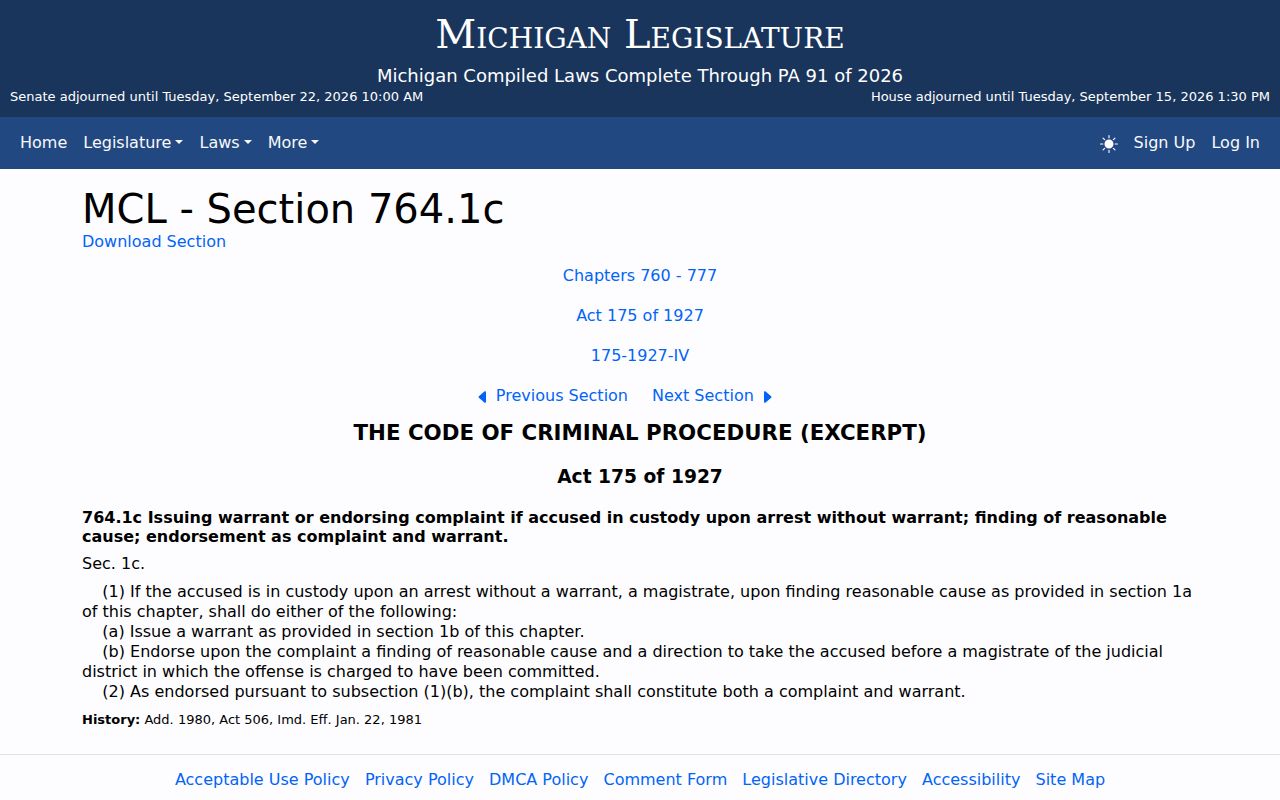
Read the statute for the general process. For anything specific to a Delta County arrest warrant, ask the issuing court.
Arrest Warrants: What They Contain
Delta County publishes no warrant-number format or field list. Think of the record as a set of parts. Michigan forms show what a court file can carry, and the issuing court confirms which parts fit a given case. A case number such as Year / Number / Type is the key you use to request the file.
| Case and Court | The case number, the court, and the judge or magistrate on the file |
|---|---|
| Person Identifiers | Name and limited identifiers. Sensitive values are not public. |
| Charge and Statute | The offense alleged and the statutory citation |
| Basis | The complaint, affidavit, or sworn testimony behind the probable-cause finding |
| Process Type | Arrest warrant, summons, bench warrant, or another court process |
| Dates | Issue date and any service, return, or appearance dates on the file |
| Bond and Release | Any bond amount, release type, and conditions set by the court |
| Status | Active, served, recalled, or cleared as the court records it |
Why the Prosecutor Is Not a Warrant Lookup
The Delta County Prosecutor's Office is a case-processing participant, not a public status desk. It prosecutes adult and juvenile misdemeanors and felonies and handles civil and family-related functions. The office sits at 310 Ludington in Escanaba. It publishes a main line, a fax line, and a subpoena line, plus a staffing profile of three attorneys and five support staff. The official Prosecutor's Office page lists those functions and contacts but posts no case or warrant data.
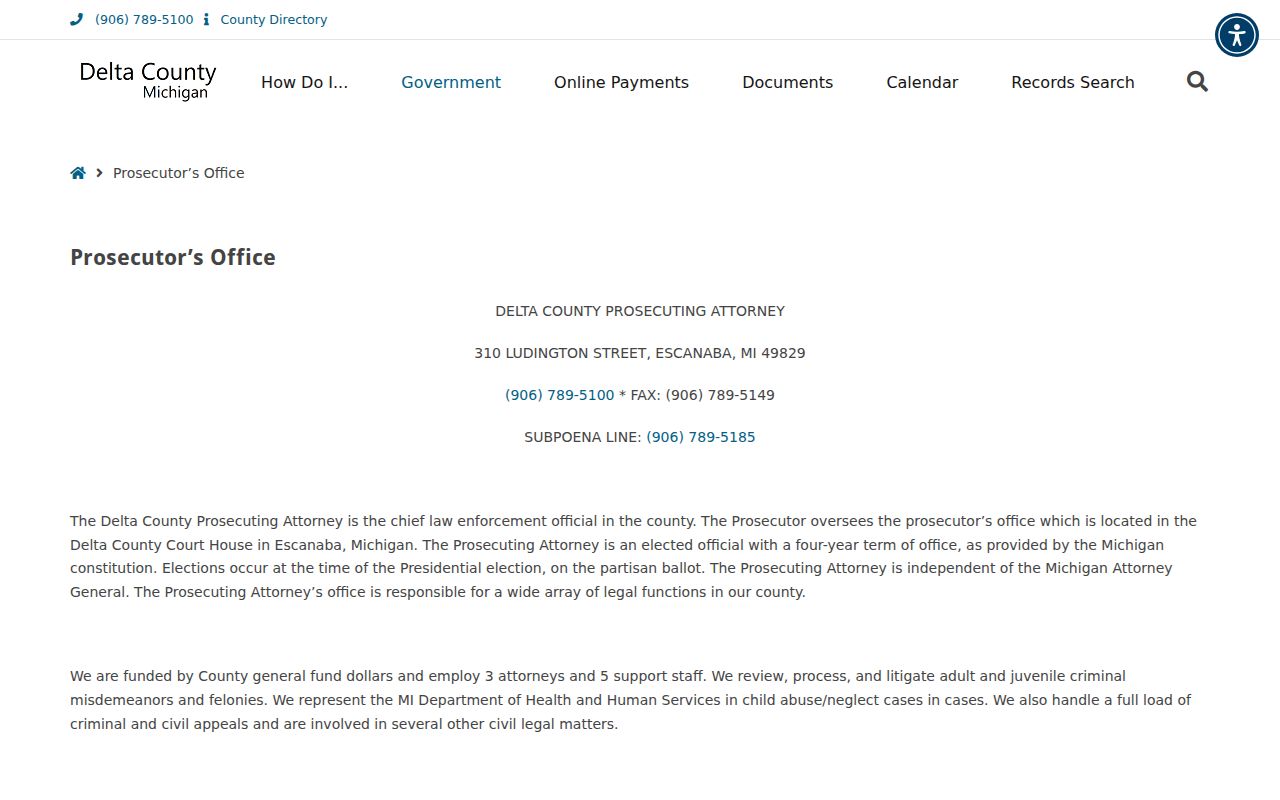
For a Delta County arrest warrant status, the court clerk is the right call. Reach the prosecutor only when the case itself makes it necessary.
How Warrants Get Served in Delta County
No public map matches each warrant to the agency that will serve it. The Delta County Sheriff's Office covers the whole county, runs the jail, and handles civil process too. Escanaba and Gladstone each have their own Department of Public Safety for incidents inside city limits. So who executes a particular Delta County arrest warrant turns on the process, the location, the agency, and any court order. Civil process offers a helpful contrast here. The sheriff serves civil papers and posts a fee schedule for that work, covering things like summons and complaints, garnishments, evictions, and subpoenas. Those fees apply to civil service only, not criminal warrant execution. The civil-process desk, in short, is not a public warrant desk.
Bond, Release, and the Delta County Jail
An arrest on a Delta County warrant typically ends at the correctional facility at 2800 College Avenue, a 156-bed jail staffed by 28 full-time correction officers. What release looks like depends on the case. Under MCR 6.106, a judge may order personal recognizance or unsecured release, conditional release, money bail, ten percent cash, surety bond, or no bond at all. The judge's order controls. Bond money does not flow through a single window. Third-party bonds are posted at the 94th District Court on weekdays. The sheriff's lobby kiosk takes bond payments around the clock, but it takes only cash bills and MasterCard or Visa debit and credit, gives no change, and adds a service fee. Court fines and costs go through a separate county payment route with a pay location code.
Arrest Warrants, Summonses, and Bench Warrants
Three different processes can all require a Delta County court appearance, and each carries its own consequences. Michigan district court guidance favors a summons over an arrest warrant in some situations. A person holding a summons is not wanted on a warrant.
| Process | How It Starts | What It Authorizes |
|---|---|---|
| Arrest warrant | A complaint with probable cause | Taking a person into custody |
| Summons | A filing with a required response | A court appearance, without custody |
| Bench warrant | A missed date or violation in an existing case | Arrest for the court-event failure |
| Search warrant | A probable-cause affidavit for a place or thing | A search or seizure, not an arrest |
How an Arrest Warrant Moves From District to Circuit
Felony cases in Delta County often begin at the district level. The 94th District Court holds first appearances, runs preliminary examinations, and sets or accepts bail, so the earliest arrest warrant activity usually sits there. When a case is bound over, the file moves up. The 47th Circuit Court takes it from that point, and later warrant questions belong to the circuit side.
That handoff is exactly why a Delta County arrest warrant search can stall. The district court may confirm a case existed and then left, while the current record now lives with the circuit court. Before you conclude anything, ask both courts which one holds the file today. One of them will have the answer.
Handling an Arrest Warrant in Your Name
If a Delta County arrest warrant carries your name, do not improvise. A lawyer can read the charge and explain the bond posture. From there, a voluntary appearance or surrender plan keeps you in front of the court instead of in a patrol car.
Important: Talk to a Michigan attorney before turning yourself in, and avoid driving if doing so could lead to a stop.
Michigan court rule MCR 6.105 offers one option. A person who presents at the issuing court within a year can seek arraignment or a recall, though exceptions apply. Timing and conditions rest with the court itself. Before anything else, ask the Delta County court how it handles this today.
Records Limits on a Delta County Arrest Warrant File
A Delta County warrant file is never fully public. Michigan FOIA allows an agency to withhold or redact investigative material and privacy-protected details. Juvenile records fall under their own confidentiality rule. Sealed or suppressed items may never reach the public docket at all.
Key Rules:
MCL 15.243 allows agencies to withhold law-enforcement investigative and privacy records.
MCL 712A.28 keeps juvenile case records nonpublic, subject to limited exceptions.
Michigan FOIA does not require an agency to create a new record or compile a list it does not already keep.
The Delta County FOIA coordinator handles requests for records that exist. A narrow ask works best. Name the case and the document rather than seeking every Delta County arrest warrant at once, and the response tends to come back cleaner.